
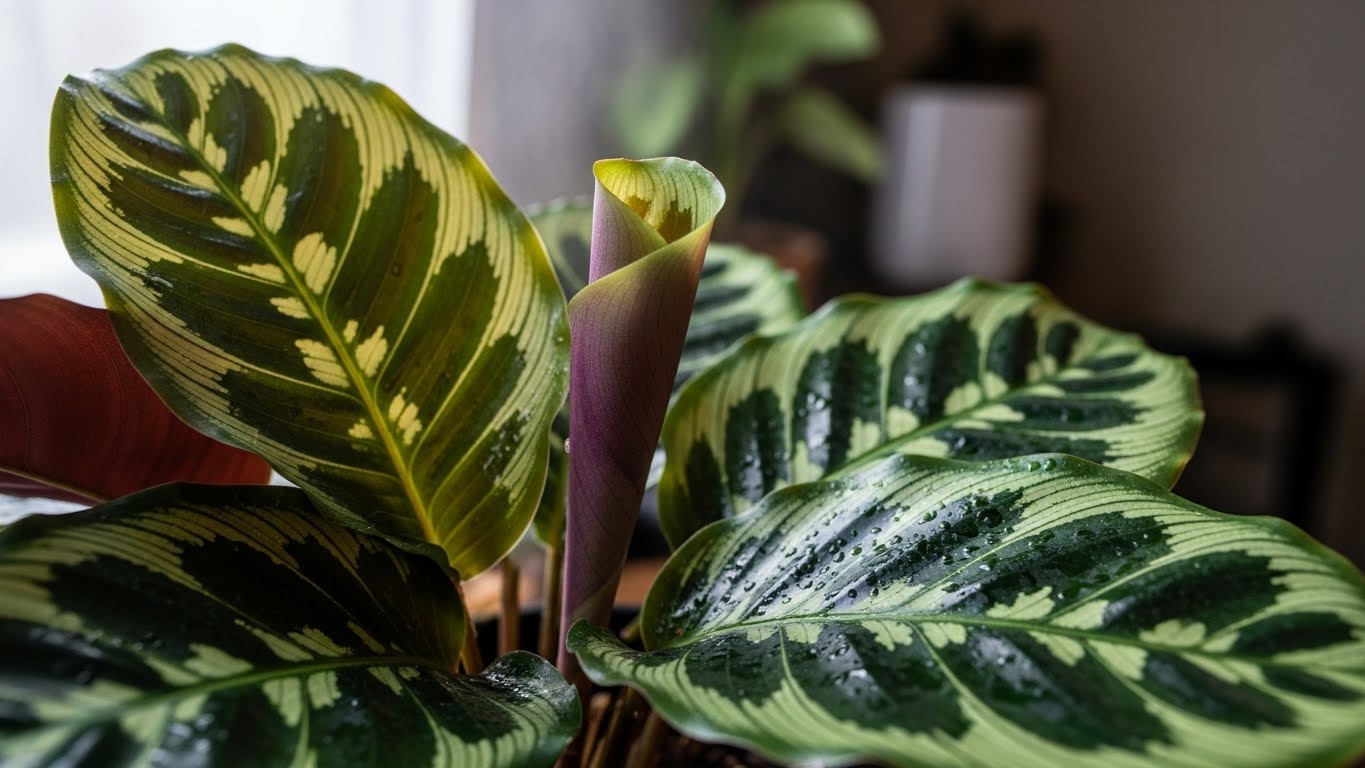
The Allure of Living Art: An Introduction to Goeppertia
To invite a Goeppertia into your home is to welcome a piece of living, breathing art. These plants, celebrated for their astonishingly ornate foliage, are not static decorations but dynamic sculptures that respond to the rhythm of the day. Their leaves, painted with intricate patterns of stripes, spots, and feathered strokes in shades of green, pink, white, and deep purple, command attention in any interior space. Yet, their most enchanting quality is a subtle, daily dance—a nightly ritual that has earned them a place among the beloved “prayer plants.” This guide is dedicated to demystifying their care, transforming their reputation from “fussy” to understood, and empowering you to cultivate vibrant, crisp-free leaves that reflect the lush beauty of their rainforest origins.
💡 If you’re just starting your journey with Calathea, this guide provides essential tips to ensure your plants thrive.
➜ Get the step-by-step guide
A Rose by Any Other Name: Goeppertia vs. Calathea
As you begin your journey, you may encounter a point of botanical confusion: the name. For decades, these plants were known almost exclusively under the genus Calathea. However, in 2012, advances in genetic research and DNA sequencing led to a significant taxonomic reassignment. Botanical studies revealed distinct evolutionary relationships within the Marantaceae family, prompting scientists to move a large number of the most popular houseplant species into a separate genus, Goeppertia.
While this change is crucial for scientific accuracy, the common name “Calathea” remains deeply embedded in the horticultural world. You will still find these plants labeled as Calathea in nurseries, online forums, and even scientific journals. To honor both scientific precision and common usage, this guide will refer to them as Goeppertia (Calathea). It is important to know that this reclassification does not alter their care requirements in any way. Both genera belong to the Marantaceae, or arrowroot family, a group renowned for its mobile foliage and shared with other “prayer plants” like Maranta, Ctenanthe, and Stromanthe.
The Nightly Ritual: Understanding Nyctinasty
The most captivating characteristic of the Goeppertia is its daily leaf movement, a phenomenon known as nyctinasty. As dusk settles, the leaves fold upward, resembling hands in prayer, and at dawn, they gracefully lower again to greet the day. This movement is not a mere reaction to light but is driven by an internal circadian rhythm, much like the sleep-wake cycles of animals.
The mechanism behind this dance is a marvel of plant physiology. At the base of each leaf stalk is a specialized, joint-like organ called the pulvinus. Throughout the day, cells within the pulvinus change their internal water pressure (turgor pressure), causing the leaf to rise and fall. Scientists theorize this adaptation serves several purposes: maximizing light absorption for photosynthesis during the day, conserving moisture at night, regulating temperature, or even protecting the plant from nocturnal predators. One compelling theory suggests the upward fold at night helps channel precious dew and rainwater down the stems to the roots. Because this movement is dependent on the plant’s hydration status, it serves as a valuable, real-time health indicator. A plant that ceases its daily “prayers” may be signaling an issue with its watering or light cycle, often before more severe symptoms like wilting or browning appear.
Echoes of the Rainforest: Why Their Origin Dictates Their Care
The key to successful calathea care lies in a single, guiding principle: emulate their natural habitat. These plants are native to the floors of tropical rainforests in the Americas, particularly Brazil, where they grow under a dense canopy. This environment is defined by warmth, high humidity, dappled or filtered light, and consistently moist, humus-rich soil.
Their reputation for being “fussy” or “difficult” is largely a misdiagnosis of an environmental mismatch. A Goeppertia is not inherently finicky; it is simply highly specialized for its native conditions. Crispy brown edges, curling leaves, and faded patterns are not signs of a temperamental plant, but predictable, logical responses to an environment that is too dry, too bright, or watered with the wrong kind of water. By reframing the challenge from “keeping a difficult plant alive” to “thoughtfully recreating a specific microclimate,” you can approach its care with a proactive mindset and achieve stunning results.
The Rainforest Blueprint: Mastering Your Goeppertia’s Environment
To cultivate a thriving Goeppertia, one must become an architect of its microclimate. The five pillars of care—light, water, humidity, soil, and temperature—are not independent variables but a tightly interconnected system. Success lies not in perfecting each element in isolation, but in understanding and balancing their dynamic interplay to create a stable, nurturing environment that echoes the rainforest floor.
A. Decoding Light: Beyond “Bright Indirect”
In the rainforest, Goeppertia are understory plants, receiving only the dappled sunlight that filters through the dense canopy above. Your goal is to replicate this low-to-medium, indirect light.
- The Rule: Never expose your plant to prolonged, direct sunlight. The harsh rays will scorch the delicate leaves, causing brown patches, fade their intricate patterns, and trigger the leaves to curl inward defensively.
- Ideal Placement: The perfect spot is often a few feet away from an east-facing window, where it can receive gentle morning sun, or near a north-facing window, which provides consistent indirect light all day. In rooms with strong southern or western exposure, place the plant well back from the window or shield it with a sheer curtain.
- Signs of Too Much Light: Colors appear faded or bleached, brown scorch spots develop, edges become crispy, and leaves curl.
- Signs of Too Little Light: Growth becomes slow or stunted, new leaves are noticeably smaller than old ones, and the vibrant variegation begins to diminish. Persistently wet soil in a low-light area can also encourage fungus gnats and root rot.
B. The Art of Watering: Moisture and Purity
Consistent moisture is vital, but the quality of the water is just as crucial. The aim is to keep the soil evenly moist, like a wrung-out sponge, but never waterlogged.
- When to Water: Check the soil every few days. When the top 1 to 2 inches feel dry, it’s time to water. This might be roughly once a week in summer and less often in winter, but always let the soil be your guide. Allowing the soil to dry out completely is a primary cause of stress and crispy leaves.
- The Purity Mandate: Goeppertia are exceptionally sensitive to the chemicals and minerals in typical tap water, such as chlorine, fluoride, and dissolved salts. Over time, these substances accumulate in the soil, creating a toxic environment that damages the plant’s fine roots. This root damage impairs the plant’s ability to absorb water and nutrients, with the visible symptom being the dreaded calathea brown edges and burnt leaf tips.
- The Solution—Distilled Water for Plants: For this reason, using purified water is one of the most impactful changes you can make. Distilled water, collected rainwater, or reverse osmosis water are the gold standards for goeppertia care. This practice is not just about giving the plant “clean” water; it is a long-term strategy for maintaining a healthy, stable soil environment. If you must use tap water, let it sit in an open container for at least 24 hours to allow some chlorine to evaporate, though this will not remove minerals or fluoride.
- Watering Technique: When you water, do so thoroughly until water flows freely from the pot’s drainage holes. After a few minutes, empty any excess water from the saucer. Never let the pot sit in standing water, as this will lead to root rot. Bottom watering—placing the pot in a tray of water for 30-45 minutes to soak up moisture from below—is an excellent method to ensure deep, even saturation without wetting the leaves.
C. The Humidity Imperative: Creating a Tropical Microclimate
Low humidity is the number one cause of crispy, brown leaf edges on a Goeppertia. Recreating the humid air of the rainforest is non-negotiable for pristine foliage.
- Ideal Levels: Aim for an ambient relative humidity (RH) of at least 50%, with an ideal range of 60–70% for the most vibrant results.
- Methods for Increasing Calathea Humidity:
- Use a Humidifier: This is the most effective and reliable way to maintain consistent high humidity around your plants.
- Create a Pebble Tray: Place the plant pot on a tray filled with pebbles and water. As the water evaporates, it creates a pocket of humid air. Ensure the bottom of the pot is sitting on the pebbles, not submerged in the water.
- Group Plants Together: Plants naturally release water vapor through a process called transpiration. Clustering your Goeppertia with other tropical plants creates a shared, humid microclimate that benefits them all.
- Choose a Strategic Location: Bathrooms and kitchens are often the most humid rooms in a home and can be excellent locations, provided they offer adequate indirect light.
- Mist Regularly: Misting with a fine spray of distilled water can provide a temporary humidity boost, but it is often not sufficient as a sole strategy. It should be used to supplement other methods.
D. The Perfect Foundation: Crafting the Ideal Soil Mix
💡 Humidity is crucial for Calathea health. Learn how to maintain the right levels for vibrant leaves.
➜ Discover proven techniques
The soil for a Goeppertia must achieve a delicate balance: it needs to retain moisture to satisfy the plant’s need for consistent dampness, yet be light and airy enough to provide oxygen to the roots and prevent waterlogging. A dense, standard potting mix will hold too much water and quickly lead to root rot.
- Expert Soil Recipe: While a pre-made African violet mix can work in a pinch, creating your own blend gives you ultimate control. A highly effective recipe is:
- 40% Coco Coir or Peat Moss: This forms the base, providing excellent moisture retention. Coco coir is a renewable and sustainable alternative to peat moss.
- 30% Perlite or Pumice: These lightweight volcanic materials create air pockets in the mix, ensuring sharp drainage and preventing soil compaction.
- 20% Orchid Bark: The larger particles of bark add structure and create larger air channels, mimicking the texture of the forest floor and further improving aeration.
- 10% Worm Castings: This organic amendment provides a gentle, slow-release source of nutrients to support healthy growth.
E. Climate Control: Temperature and Fertilization
💡 Understanding your plant’s signals can prevent issues before they escalate. Find out what to look for.
➜ Explore advanced methods
- Temperature: Goeppertia thrive in stable, warm conditions typical of most homes, ideally between 65–80°F (18–27°C). They are sensitive to sudden temperature fluctuations and cold drafts, so keep them away from open windows in winter, air conditioning vents, and direct heat sources like radiators. Temperatures below 60°F (15°C) can cause damage.
- Fertilizer: During the active growing season of spring and summer, feed your plant once a month with a balanced liquid houseplant fertilizer diluted to half or even quarter strength. Goeppertia are sensitive to over-fertilization, which can burn their roots and contribute to the mineral buildup that causes brown leaf edges. Do not fertilize during the fall and winter when the plant’s growth naturally slows.
A Collector’s Gallery: A Guide to Popular Goeppertia (Calathea) Varieties
The Goeppertia genus is incredibly diverse, offering a stunning array of foliage for every taste. Here are some of the most popular and visually distinct varieties you may encounter:
- Goeppertia orbifolia (Calathea Orbifolia): A true statement piece, prized for its large, round, leathery leaves marked with elegant, silvery-green stripes.
- Goeppertia roseopicta (Rose-Painted Calathea): This species includes several breathtaking cultivars:
- ‘Medallion’: Features large, dark green leaves with a central feathered pattern of silver and light green. The undersides are a rich, deep burgundy.
- ‘Dottie’: A dramatic variety with leaves so dark they appear almost black, adorned with a striking, hot-pink feathered outline.
- Goeppertia makoyana (Peacock Plant): Its common name is well-earned. The pale green leaves are intricately marked with dark green lines and ovals that resemble a peacock’s tail feather, a pattern mirrored in purple on the undersides.
- Goeppertia ornata (Pinstripe Calathea): Characterized by dark green leaves elegantly painted with fine, parallel pinstripes, which start as a delicate pink and mature to a creamy white.
- Goeppertia insignis (Rattlesnake Plant): A visually and texturally unique variety with long, lance-shaped leaves that have wavy edges. The bright green tops are patterned with alternating dark green ovals, and the undersides are a deep purple.
- Goeppertia zebrina (Zebra Plant): This plant boasts velvety, bright green leaves with bold, dark green stripes radiating from the central vein, much like a zebra’s coat.
- Goeppertia ‘White Fusion’: A highly sought-after but notoriously challenging cultivar. Its leaves are a spectacular marbled tapestry of white, green, and lilac. The large white sections lack chlorophyll, making the plant more delicate and highly sensitive to its environment.
- Goeppertia musaica ‘Network’: As its name suggests, this variety features a unique and mesmerizing mosaic-like pattern of tiny, intersecting lines across the entire leaf surface, creating a “network” effect.
The Plant Doctor: A Troubleshooting Guide to Flawless Foliage
The leaves of a Goeppertia are highly expressive, and their symptoms are a language of stress. Learning to interpret these visual cues allows you to diagnose and resolve issues before they become severe. Curling leaves, for example, are a physical attempt to reduce surface area and limit moisture loss, while brown edges represent cell death in the areas furthest from the plant’s vascular system. This section serves as a translation guide to help you understand what your plant is communicating.
Table 1: The Calathea Diagnostic Chart
Symptom | Probable Cause(s) | Solution / Reference |
Crispy Brown Edges/Tips | Low humidity; minerals/chemicals in tap water; underwatering. | Increase humidity; switch to distilled water; water more consistently. See Sec. II-C, II-B. |
Curling Leaves (Inward) | Underwatering; low humidity; too much direct sun; cold drafts. | Check soil moisture and water if dry; increase humidity; move to a shadier, warmer spot. See Sec. II-B, II-C, II-A. |
Yellowing Leaves | Overwatering (most common); severe underwatering; pests; natural aging of oldest leaves. | Check soil for sogginess; allow to dry more between waterings; inspect roots for rot. See Sec. IV-A. |
Fading Leaf Patterns | Too much direct sunlight (most common); too little light. | Move out of direct sun to a bright, indirect spot. See Sec. II-A. |
Mushy Stems / Black Base | Overwatering leading to root and stem rot. | A serious sign. Inspect roots immediately; trim rot and repot in fresh soil. See Sec. IV-A. |
Fine Webbing on Undersides | Spider mite infestation. | Isolate plant; wash leaves thoroughly; treat with neem oil or insecticidal soap. See Sec. IV-B. |
A. In-Depth Symptom Analysis
- The Case of the Crispy Edges (Calathea Brown Edges): This is the most frequent complaint from Goeppertia owners. It is almost always a direct result of an environmental issue.
- Causes: The three primary culprits are: 1) Low ambient humidity, which causes the delicate leaf margins to dry out; 2) Mineral and chemical buildup in the soil from using tap water; and 3) Allowing the soil to dry out too much between waterings.
- Solutions: Address the causes systematically. First, use a hygrometer to measure humidity and take steps to increase it to above 50%. Second, immediately stop using tap water and switch to distilled, rain, or filtered water. Third, adjust your watering schedule to ensure the soil remains consistently moist. While you can trim the brown edges with clean scissors for cosmetic purposes, this will not solve the underlying problem.
- Decoding Curling Leaves: When a Goeppertia curls its leaves inward, it is actively trying to protect itself from a stressor.
- Causes: The most common reason is thirst. The plant curls its leaves to reduce surface area and minimize water loss through transpiration. Low humidity has the same effect. Other causes include exposure to excessive direct sunlight or cold drafts.
- Solutions: Your first step should always be to check the soil’s moisture level. If it’s dry, a thorough watering should cause the leaves to unfurl within hours or a day. If the soil is moist, evaluate the plant’s location for drafts or direct sun and move it to a more suitable spot.
- When Leaves Turn Yellow: Yellowing leaves (chlorosis), particularly on the lower parts of the plant, are often a sign of a problem at the root level.
- Causes: The number one cause is overwatering, which suffocates the roots and leads to root rot. When roots are damaged, they cannot absorb water and nutrients, causing the leaves to yellow and die. While natural aging will cause the oldest, lowest leaf to occasionally yellow and drop off, widespread yellowing is a red flag.
- Solutions: Immediately reduce watering frequency and ensure the pot has excellent drainage. If the problem continues, gently remove the plant from its pot and inspect the roots. Healthy roots are firm and white or light tan; rotting roots will be dark, mushy, and may have a foul odor. Use sterile scissors to trim away all affected roots before repotting into a fresh, appropriate soil mix.
B. Pest Patrol: Conquering Spider Mites and Other Intruders
The dry indoor conditions that Goeppertia despise are, unfortunately, the perfect breeding ground for their most common pest: spider mites.
- The Arch-Nemesis: Spider Mites: These tiny arachnids are difficult to see with the naked eye but can cause significant damage.
- Identification: The first tell-tale sign is often fine, silky webbing on the undersides of leaves and where the stems meet the leaves. You may also notice a stippled or speckled pattern on the leaves as the mites suck the contents from plant cells. Shaking a leaf over a white piece of paper may reveal tiny, moving red or brown dots.
- Treatment Protocol:
- Isolate: The moment you suspect spider mites, move the infested plant far away from your other houseplants to prevent their spread.
- Wash: Take the plant to a shower or use a hose to thoroughly spray down all leaf surfaces, especially the undersides, with lukewarm water. This will physically dislodge a large portion of the population.
- Treat: After washing, treat the plant with a horticultural oil like neem oil or an insecticidal soap solution. Be sure to coat every surface of the plant. This process must be repeated every 5-7 days for at least three to four weeks to eliminate newly hatched mites and break their life cycle.
- Other Pests: Aphids and mealybugs can also occasionally be a problem. They can be treated with the same wash-and-spray protocol used for spider mites.
Advanced Care and Interior Styling
Once you have mastered the environmental basics, you can move on to long-term stewardship and aesthetic integration, ensuring your Goeppertia not only survives but becomes a magnificent, multiplying feature in your home.
A. Expanding Your Collection: Propagation by Division
Unlike many houseplants, Goeppertia cannot be propagated from a simple stem or leaf cutting. The only reliable method is division of the plant’s underground rhizome system.
- The Timing: The best time to propagate is in the spring, ideally during a routine repotting. The plant is entering its active growth phase and will recover from the stress of division more quickly.
- Step-by-Step Guide:
- The day before you plan to divide, water your plant thoroughly to hydrate it and reduce shock.
- Gently remove the entire plant from its pot and carefully shake or brush off the excess soil to expose the root ball.
- Examine the root system to identify natural clumps or sections. A viable division must have its own cluster of leaves and a healthy portion of the root system attached.
- Using your hands, gently tease the clumps apart. The roots are fragile, so work slowly and patiently. If the rhizomes are too tough to separate by hand, use a clean, sharp knife to make a decisive cut.
- Pot each new division into its own container that is only slightly larger than its new root ball. Using a pot that is too large can lead to waterlogged soil. Use a fresh, moist batch of the recommended soil mix.
- After potting, water the divisions well. Keep them in a warm, humid location with indirect light. To boost humidity and aid recovery, you can place a clear plastic bag over the pot to create a mini-greenhouse effect, making sure to open it for air circulation daily.
B. Repotting for Health and Growth
Goeppertia generally need to be repotted every one to two years, or whenever they show signs of being root-bound.
- When to Repot: Signs that it’s time for a new pot include roots growing out of the drainage holes, slowed growth, or the soil drying out extremely quickly after watering.
- Procedure: Choose a new pot that is only 1-2 inches larger in diameter than the current one. Gently remove the plant, inspect the roots for any signs of rot (trimming away any mushy parts), and place it in the new pot, backfilling with fresh, appropriate soil.
C. Aesthetic Integration: Decorating with Living Patterns
The visual power of Goeppertia makes them a versatile tool for interior design.
- Foliage as a Focal Point: The bold, graphic patterns of varieties like G. orbifolia or G. roseopicta ‘Dottie’ can serve as a living centerpiece on a coffee table, bookshelf, or pedestal, adding a touch of organic modernism to a room.
- Creating a Lush Jungle Vibe: Grouping several Goeppertia varieties together, or mixing them with other humidity-loving plants like ferns, creates a lush, layered, and visually dynamic display. This technique is not only beautiful but also functional, as it helps create the humid microclimate these plants need to thrive.
- Showcasing Color: Many varieties boast stunning purple or burgundy undersides. To show off this hidden beauty, place these plants on shelves or stands at or above eye level, where their nightly upward fold will reveal the vibrant contrast.
D. Peace of Mind: A Pet-Friendly Beauty
One of the most reassuring qualities of the Goeppertia genus is its safety for households with pets and children.
💡 Watering is a fundamental aspect of plant care. Master the right watering schedule for your Calathea.
➜ Master this approach
- Toxicity Confirmation: According to the American Society for the Prevention of Cruelty to Animals (ASPCA), plants in the Calathea genus (which includes those now classified as Goeppertia) are officially listed as non-toxic to cats, dogs, and horses.
- A Note of Caution: While they are not poisonous, consuming a large quantity of any fibrous plant matter can cause mild gastrointestinal upset, such as vomiting or diarrhea, in pets. It is always a good practice to place plants where curious pets are less likely to nibble on them, protecting both your plant’s beauty and your pet’s comfort.


