
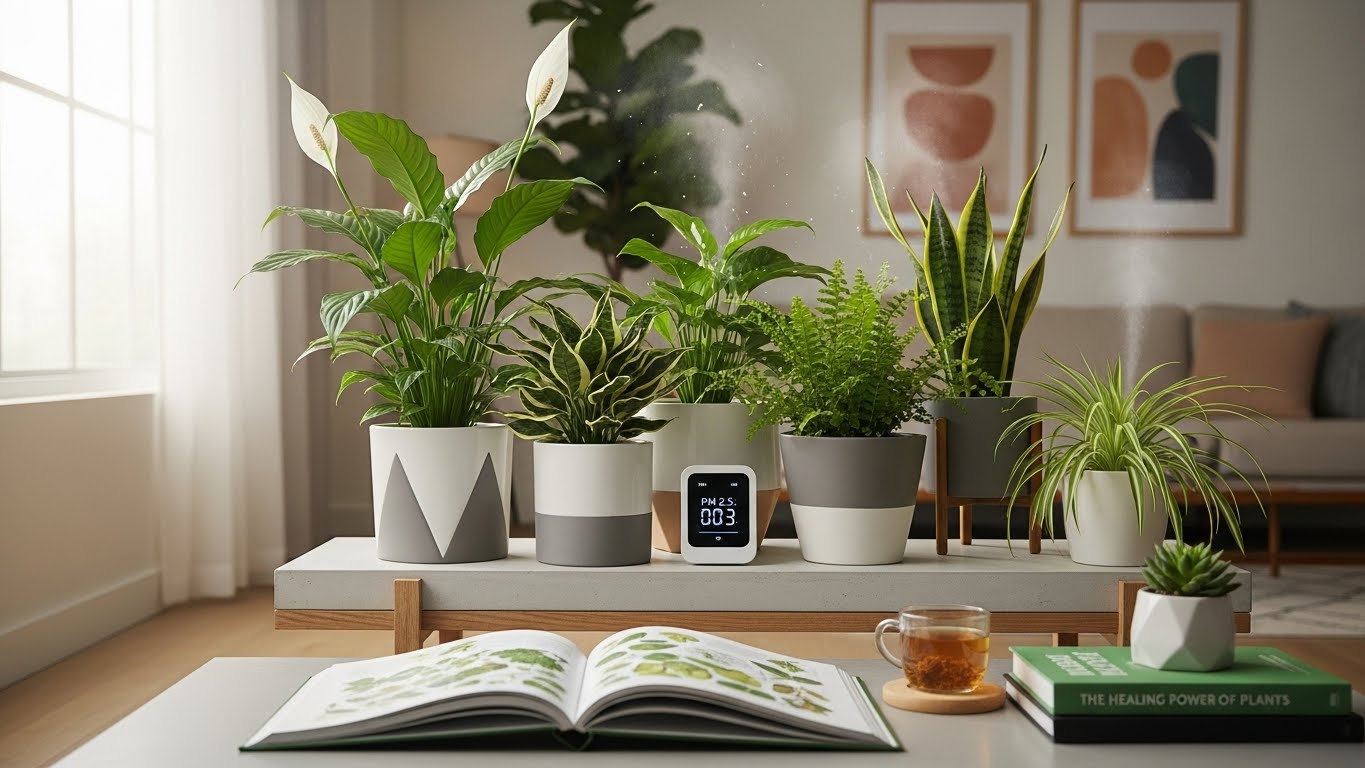
PART 1: The Legend of the NASA Clean Air Study: From Space Stations to Living Rooms
Section 1.1: Introduction – A Myth Takes Root
💡 Are you curious if those indoor plants truly enhance your air quality? Dive deeper into the science behind their effectiveness.
➜ Uncover the truth about air purifying plants
The landmark 1989 NASA Clean Air Study demonstrated that plants remove pollutants in sealed lab chambers, a finding often misapplied to homes. In reality, effective indoor air quality hinges on ventilation and filtration. Houseplants are a wonderful complement for well-being but cannot replace these primary methods.
The idea that a few strategically placed houseplants can purify the air in our homes is a compelling and persistent narrative. It has blossomed across lifestyle blogs, home decor magazines, and garden center displays, offering an aesthetically pleasing, “natural” solution to the invisible threat of indoor air pollution. This popular belief can be traced back to a single, foundational piece of research: the 1989 NASA Clean Air Study. However, the popular interpretation of this study has strayed significantly from its original scientific context and purpose.
The research was not conceived as a guide for interior decorating but as a rigorous scientific investigation for one of the most extreme indoor environments imaginable: a space station. The study’s origins lie in the “Sick Building Syndrome” crisis that emerged in the 1970s and 1980s. In response to the oil embargo, buildings were constructed to be more energy-efficient, meaning they were sealed more tightly. This reduction in ventilation led to the accumulation of airborne pollutants, particularly volatile organic compounds (VOCs), which are gaseous chemicals “off-gassed” from synthetic building materials, furnishings, and office equipment. Workers in these buildings reported a range of health complaints, from headaches to respiratory irritation. NASA scientists recognized that future space habitats would be the ultimate sealed environments, facing similar, if not more severe, challenges with off-gassing from synthetic materials in a closed-loop system. Their objective was to explore the potential of biological systems—specifically, common houseplants—to act as a low-energy, self-regulating life-support component for cleaning the air on long-duration space missions.
Section 1.2: Inside the Chamber: The Science of Phytoremediation
To test the air-purifying capabilities of plants, the research team, led by Dr. B.C. Wolverton, developed a highly controlled experimental protocol. This methodology is the key to understanding both what the study proved and why its findings are so often misapplied.
Individual plants were placed inside small, sealed plexiglass chambers, each with a volume of approximately 0.9 cubic meters. These chambers were hermetically sealed, meaning there was no air exchange with the outside environment—a critical detail that mimics a space station but not a typical home. Researchers then injected a controlled concentration of a single VOC into the chamber. The primary chemicals tested were benzene, formaldehyde, and trichloroethylene, chosen for their prevalence in synthetic materials. Over a period of 24 to 72 hours, air samples were periodically taken from the chamber and analyzed to measure the rate at which the VOC concentration decreased.
The results were promising. The study demonstrated that plants could indeed remove a significant percentage of these chemicals from the sealed chambers, a process known as phytoremediation. However, a deeper analysis revealed a more complex mechanism at play. It was not just the leaves “breathing in” toxins. Subsequent research, including studies by Wolverton himself, showed that a substantial portion of the VOC removal—in some cases, 50% to 65%—was attributable to the microorganisms living in the soil and the area immediately surrounding the plant’s roots, a zone known as the rhizosphere. These soil microbes are able to adapt, using the organic compounds as a food source and breaking them down into harmless components. This discovery fundamentally reframes the popular image of air purification, shifting the focus from the plant’s foliage to the entire plant-soil ecosystem.
This understanding reveals that the original study was an engineering proof-of-concept, not a consumer guide. It successfully demonstrated that a plant-based biological system could function under specific, controlled conditions. Dr. Wolverton himself understood that a passive potted plant had limitations in a dynamic environment. His later work involved developing and patenting active biofilters that used fans to force large volumes of contaminated air through a combination of plant roots and activated carbon, stating that this could improve the cleaning capacity “exponentially”. The popular myth remains frozen in 1989, ignoring the crucial fact that the study’s own lead scientist recognized the need for an engineered solution to make the principle of phytoremediation practical and effective in a real-world setting.
PART 2: From Lab to Living Room: A Scientific Reality Check
Section 2.1: The Air Exchange Fallacy: Why Your Home Isn’t a Spaceship
The single most significant factor that separates the NASA lab chambers from a home or office is ventilation. The sealed chambers had an air exchange rate (ACH) of zero, meaning no air entered or left. In contrast, a typical building is in constant flux. Air leaks through cracks, is exchanged when doors and windows are opened, and is circulated by HVAC systems. This process of air exchange constantly dilutes the concentration of indoor pollutants.
To properly quantify the impact of an air-cleaning device in a real-world setting, environmental engineers use a metric called the Clean Air Delivery Rate (CADR). This standard measures the volume of filtered air a cleaner provides. In a landmark 2019 review published in the Journal of Exposure Science & Environmental Epidemiology, researchers Michael Waring and Bryan Cummings of Drexel University applied the CADR metric to the data from the NASA study and other similar experiments.
Their analysis delivered a clear and decisive conclusion: the rate at which natural air exchange removes VOCs from a room is vastly greater than the rate at which plants can. The purification effect of plants is so slow that it is completely overwhelmed by the normal ventilation that occurs in any building. In practical terms, opening a window for just a few minutes will cleanse the air of VOCs far more effectively than a room filled with plants could over many hours or even days.
Section 2.2: The Problem of Scale: The Impractical Plant Density
The second critical flaw in applying the NASA findings to the home is the issue of scale. The lab chambers were small, and the ratio of plant to air volume was high. To replicate those conditions and achieve a meaningful reduction in VOCs in a typical room, the number of plants required is staggeringly impractical.
The Drexel University study calculated that to compete with a building’s standard air exchange from an HVAC system or a few open windows, one would need to place between 100 and 1,000 plants per square meter of floor space. To put that in perspective, a small 10-foot by 10-foot room (roughly 9.3 square meters) would require between 930 and 9,300 plants to achieve a significant air-purifying effect. An earlier internal memo from the U.S. Environmental Protection Agency (EPA) reviewing the NASA study came to a similar conclusion, estimating that a “typical house” would require 680 plants to match the lab results. Even Dr. Wolverton’s later, more practical recommendation of two good-sized plants per 100 square feet (about 9.3 square meters) falls far short of the density needed for effective air purification, though it is a more reasonable goal for aesthetic purposes. The visual of turning a living room into a dense, impassable jungle effectively illustrates the impracticality of relying on plants as a primary air-cleaning strategy.
Section 2.3: A Deeper Look: The Claim vs. Reality Table
The disparity between the popular perception of the NASA study and the scientific reality of indoor air quality can be summarized by directly comparing the common claims with the evidence.
Claim (Based on Popular Misinterpretation) | The Scientific Reality (In a Typical Home) |
A few “NASA plants” will purify a room. | The purification rate is negligible. To match the effects of simply opening a window, you would need a density of 100-1,000 plants per square meter of floor space. |
Plants are a natural substitute for air filters. | The Clean Air Delivery Rate (CADR) of plants is minuscule compared to mechanical ventilation and filtration. Normal air exchange in a home dilutes pollutants far faster than plants can remove them. |
The plant’s leaves “breathe in” toxins. | While leaves play a role, a significant portion of VOC removal (up to 65%) is performed by microbes in the plant’s root system (the rhizosphere). |
The NASA study is a guide for home air quality. | The study was conducted in small, hermetically sealed chambers with no air exchange, a condition that does not exist in homes or offices. Its purpose was to explore options for closed-loop systems like space stations. |
The enduring popularity of this myth, despite such overwhelming counter-evidence, speaks to the power of biophilia—the innate human desire to connect with nature. The idea of a plant silently and beautifully cleaning our air is far more appealing than the mechanical reality of fans and filters. The myth persists because it offers an elegant, low-effort, “green” solution to a complex and invisible problem. To effectively move past the myth, it is essential not to dismiss plants, but to re-contextualize their benefits, celebrating them for their proven positive impact on mental well-being and aesthetics while turning to more robust methods for air purification.
PART 3: The Definitive Guide to Achieving Healthier Indoor Air
Section 3.1: The Gold Standard: A Prioritized Framework for IAQ
💡 Looking to enhance your indoor air quality? Check out our curated list of the top air purifying plants for 2025.
➜ Discover the best air purifying plants for your home
While houseplants are not an effective air purification strategy, a clear, evidence-based hierarchy of methods exists for genuinely improving indoor air quality (IAQ). This framework, supported by governmental bodies like the EPA and health organizations such as the American Lung Association, prioritizes actions from most to least effective.
Tier 1: Source Control (The Most Effective Strategy)
The most direct and impactful way to improve IAQ is to prevent pollutants from entering the air in the first place. This strategy, known as source control, involves eliminating or reducing the products and materials that off-gas harmful chemicals.
💡 Are you misled by common misconceptions about air purifying plants? Explore the myths and realities to make informed choices.
➜ Debunk common myths about indoor plants
Actionable Steps for Source Control:
- Choose Low-VOC Products: When painting, renovating, or buying new furniture, opt for products labeled as “low-VOC” or “no-VOC.” This includes paints, sealants, adhesives, and pressed-wood furniture.
- Avoid Synthetic Fragrances: Many air fresheners, cleaning products, and candles release a complex mixture of VOCs into the air. Reduce their use in favor of fragrance-free options or natural ventilation.
- Ventilate Combustion Appliances: Ensure that gas stoves, water heaters, and furnaces are properly maintained and vented to the outdoors to prevent the buildup of combustion byproducts like carbon monoxide (CO) and nitrogen dioxide (NO2).
- Air Out New Items: New carpets, mattresses, or furniture can be significant sources of off-gassing. If possible, allow them to air out in a well-ventilated space like a garage before bringing them into your main living area.
Tier 2: Ventilation (Dilution is the Solution)
The second line of defense is ventilation: diluting and removing polluted indoor air by replacing it with fresher outdoor air.
Actionable Steps for Ventilation:
- Open Windows and Doors: Weather permitting, open windows for 10-15 minutes each day to facilitate a full exchange of air.
- Use Exhaust Fans: Routinely use kitchen and bathroom exhaust fans that vent directly outside. These are highly effective at removing moisture and pollutants generated during cooking and showering.
- Maintain HVAC Systems: Ensure your home’s heating, ventilation, and air conditioning (HVAC) system is in good working order and regularly change its filters according to manufacturer recommendations.
Tier 3: Mechanical Filtration (Targeted Removal)
After minimizing sources and maximizing ventilation, air cleaners can be used to capture remaining airborne contaminants. However, it is critical to select the right technology for the target pollutant.
- HEPA Filters for Particulate Matter: A High-Efficiency Particulate Air (HEPA) filter is the gold standard for removing particulate matter. By definition, a True HEPA filter must capture at least 99.97% of airborne particles that are 0.3 microns in size. This makes them extremely effective against dust, pollen, pet dander, mold spores, and some bacteria and viruses.
- Activated Carbon for Gases and VOCs: Critically, HEPA filters are designed to capture solid particles and are ineffective against gaseous pollutants like the VOCs studied by NASA. To remove VOCs, odors, and other chemical fumes, an air purifier must contain an activated carbon filter. This porous material works through a process called adsorption, where gas molecules chemically bond to the carbon’s surface. For effective VOC removal, the purifier should have a substantial amount of activated carbon, not just a thin, coated pre-filter.
The most comprehensive portable air purifiers combine a True HEPA filter with a thick bed of activated carbon, allowing them to address both particulate and gaseous pollutants simultaneously. This addresses a common consumer misunderstanding: purchasing a standard HEPA-only purifier will not solve the VOC problem that the NASA plant myth purports to address.
Section 3.2: The Supporting Cast: Humidity and the True Role of Plants
Beyond the primary strategies, managing indoor humidity is a crucial supporting element for a healthy home environment. Research indicates that maintaining a relative humidity level between 40% and 50% offers multiple benefits. This range can help minimize the transmission and viability of some airborne viruses, inhibit the growth of mold and dust mites, and support the human respiratory system’s natural defense mechanisms, like mucociliary clearance. This can be achieved using humidifiers in dry conditions and dehumidifiers in damp conditions, monitored with a simple hygrometer.
With a comprehensive IAQ strategy in place, houseplants can be reintroduced into the home for the right reasons. They are not effective air purifiers, but their value for human well-being is well-documented. They reduce stress, improve mood, and satisfy our innate connection to the natural world.
Better Air at Home: An Expert’s Priority List
- Source Control: First, remove or reduce pollutant sources. Choose low-VOC products, avoid synthetic fragrances, and ensure proper venting for combustion appliances.
- Ventilation: Regularly exchange indoor air with outdoor air. Open windows daily and use exhaust fans in kitchens and bathrooms.
- Filtration: Use a high-quality portable air cleaner with both a True HEPA filter (for particulates) and a substantial activated carbon filter (for VOCs and odors).
- Humidity Control: Maintain indoor humidity between 40-50% using humidifiers or dehumidifiers to support respiratory health and inhibit mold growth.
- Add Plants: Once the fundamentals are addressed, introduce houseplants for their proven benefits to mental well-being, aesthetics, and connection to nature.
PART 4: A Curated Catalog of Indoor Plants for the Modern, Well-Informed Home
Section 4.1: The Plant List: From NASA Classics to Contemporary Favorites
With a realistic understanding of their role, we can embrace indoor plants for their aesthetic and psychological benefits. This catalog features plants from the original NASA study alongside modern favorites, with a primary focus on proper care and, most importantly, safety for all members of your household, including pets.
NASA Classics
- Snake Plant (Dracaena trifasciata)
- NASA Study Status: A top performer in the 1989 study for removing benzene, formaldehyde, and trichloroethylene.
- Care Requirements:
- Light: Extremely tolerant of low light but prefers bright, indirect light.
- Water: Water thoroughly but allow soil to dry out completely between waterings. Highly drought-tolerant and prone to root rot if overwatered.
- Humidity: Average household humidity is sufficient.
- Pet Safety: Pet Caution: Toxic to cats and dogs if ingested. Contains saponins that can cause nausea, vomiting, and diarrhea.
- Peace Lily (Spathiphyllum ‘Mauna Loa’)
- NASA Study Status: Effective at removing benzene, formaldehyde, trichloroethylene, xylene, and ammonia.
- Care Requirements:
- Light: Prefers bright, indirect light but tolerates low light. Avoid direct sun, which can scorch leaves.
- Water: Keep soil consistently moist but not soggy. It will visibly droop when thirsty.
- Humidity: Thrives in high humidity, making it ideal for kitchens or bathrooms.
- Pet Safety: Pet Caution: Toxic to cats and dogs. Contains insoluble calcium oxalate crystals that cause intense oral irritation, drooling, vomiting, and difficulty swallowing upon chewing.
- Spider Plant (Chlorophytum comosum)
- NASA Study Status: Noted for its high removal rate of formaldehyde.
- Care Requirements:
- Light: Prefers bright, indirect light. Direct sun can scorch the leaves.
- Water: Water when the top inch or two of soil feels dry. Forgiving of occasional neglect.
- Humidity: Adapts to average household humidity but appreciates occasional misting.
- Pet Safety: Pet-Safe: Non-toxic to cats and dogs, making it an excellent choice for homes with pets.
- English Ivy (Hedera helix)
- NASA Study Status: A top performer, particularly effective at removing benzene.
- Care Requirements:
- Light: Prefers bright, indirect light but is tolerant of a wide range of light conditions.
- Water: Keep the soil moist but not soggy. Water when the top inch of soil is dry.
- Humidity: Loves high humidity and benefits from regular misting.
- Pet Safety: Pet Caution: Toxic to cats, dogs, and horses. Ingestion can cause vomiting, abdominal pain, drooling, and diarrhea.
- Golden Pothos (Epipremnum aureum)
- NASA Study Status: Effective at removing formaldehyde, benzene, and xylene.
- Care Requirements:
- Light: Thrives in bright, indirect light but is famously tolerant of low light.
- Water: Water thoroughly when the top 50% of the soil is dry. Very forgiving if you forget to water.
- Humidity: Prefers high humidity but does well in average household conditions.
- Pet Safety: Pet Caution: Toxic to cats and dogs. Contains insoluble calcium oxalate crystals, causing oral irritation, pain, drooling, and vomiting if chewed.
- Rubber Plant (Ficus elastica)
- NASA Study Status: Noted for removing formaldehyde.
- Care Requirements:
- Light: Prefers bright, indirect light. Avoid direct sun.
- Water: Keep soil evenly moist. Allow the top half of the soil to dry out between waterings to prevent root rot.
- Humidity: Prefers moderate humidity (40-50%) but adapts well to average room conditions.
- Pet Safety: Pet Caution: Mildly toxic to cats and dogs. The sap can cause oral and gastrointestinal irritation, leading to drooling, vomiting, and diarrhea.
- Boston Fern (Nephrolepis exaltata)
- NASA Study Status: Highly effective at removing formaldehyde and xylene.
- Care Requirements:
- Light: Thrives in bright, indirect sunlight, such as near a window with filtered light.
- Water: Requires consistently moist soil; do not let it dry out completely.
- Humidity: Needs high humidity to prevent fronds from drying out. Ideal for a bathroom or requires frequent misting.
- Pet Safety: Pet-Safe: Non-toxic to cats and dogs.
- Areca Palm (Dypsis lutescens)
- NASA Study Status: One of the top-rated plants for overall air purification in the study.
- Care Requirements:
- Light: Requires bright, indirect light, such as from a south- or east-facing window.
- Water: Keep the soil lightly moist during the growing season, but do not oversaturate.
- Humidity: Prefers humidity levels above 40% and benefits from misting if the air is dry.
- Pet Safety: Pet-Safe: Non-toxic to cats, dogs, and horses.
- Dracaena ‘Marginata’ (Dracaena marginata)
- NASA Study Status: Effective at removing benzene, formaldehyde, trichloroethylene, and xylene.
- Care Requirements:
- Light: Prefers bright, indirect light. Can tolerate lower light but may grow slowly.
- Water: Water when the top inch of soil is dry. Drought-tolerant.
- Humidity: Average household humidity is sufficient.
- Pet Safety: Pet Caution: Toxic to cats and dogs. Contains saponins, which can cause vomiting (sometimes with blood), drooling, weakness, and loss of appetite.
- Chinese Evergreen (Aglaonema modestum)
- NASA Study Status: Effective at removing benzene and formaldehyde.
- Care Requirements:
- Light: Tolerates low light well but prefers medium to bright indirect light. Variegated types need more light to maintain their color.
- Water: Keep soil moist but not soggy; allow the top two inches to dry out between waterings.
- Humidity: Prefers high humidity (60-70%).
- Pet Safety: Pet Caution: Toxic to cats and dogs due to insoluble calcium oxalates, causing oral pain, swelling, drooling, and vomiting.
- Bamboo Palm / Parlor Palm (Chamaedorea seifrizii / elegans)
- NASA Study Status: A top performer for filtering formaldehyde and xylene.
- Care Requirements:
- Light: Thrives in partial sun or shade; does not like direct sun.
- Water: Keep soil consistently moist but not soggy.
- Humidity: Prefers a humid environment, making it a good choice for bathrooms or kitchens.
- Pet Safety: Pet-Safe: Non-toxic to cats and dogs.
- Weeping Fig (Ficus benjamina)
- NASA Study Status: Effective at removing formaldehyde, xylene, and toluene.
- Care Requirements:
- Light: Needs a bright room with plenty of indirect sunlight. Not tolerant of being moved.
- Water: Keep steadily moist, but do not let it sit in water. Requires a consistent watering schedule.
- Humidity: Prefers high humidity; benefits from misting or a humidifier.
- Pet Safety: Pet Caution: Toxic to cats and dogs. The sap contains ficin and ficusin, which can cause skin irritation and gastrointestinal distress, including vomiting and diarrhea.
- Gerbera Daisy (Gerbera jamesonii)
- NASA Study Status: Noted for its ability to remove trichloroethylene and benzene.
- Care Requirements:
- Light: Needs plenty of bright, indirect sunlight to bloom.
- Water: Water when the top inch of soil is dry. Requires good drainage to prevent root rot.
- Humidity: Prefers good air circulation to prevent fungal diseases.
- Pet Safety: Pet-Safe: Non-toxic to cats, dogs, and horses.
- Florist’s Chrysanthemum (Chrysanthemum morifolium)
- NASA Study Status: An air-purifying all-star, removing benzene, formaldehyde, trichloroethylene, xylene, and ammonia.
- Care Requirements:
- Light: Requires a cool, brightly lit location to thrive indoors.
- Water: Keep soil thoroughly moist but ensure good drainage.
- Humidity: Average household humidity is acceptable with good air circulation.
- Pet Safety: Pet Caution: Toxic to cats, dogs, and horses. Can cause vomiting, diarrhea, drooling, and loss of coordination if ingested.
Modern Favorites
- ZZ Plant (Zamioculcas zamiifolia)
- NASA Study Status: Not part of the original study but celebrated for its extreme hardiness.
- Care Requirements:
- Light: Thrives in low to bright indirect light. Avoid direct sun.
- Water: Extremely drought-tolerant due to its water-storing rhizomes. Water only when the soil has completely dried out, roughly every 2-3 weeks.
- Humidity: Tolerates dry air and average home humidity perfectly.
- Pet Safety: Pet Caution: Mildly toxic to cats and dogs. Contains calcium oxalate crystals that can cause oral irritation and gastrointestinal upset if chewed.
- Cast Iron Plant (Aspidistra elatior)
- NASA Study Status: Not in the original study, but valued for its near-indestructible nature.
- Care Requirements:
- Light: An excellent choice for low-light conditions. Direct sun will scorch its leaves.
- Water: Very drought-tolerant. Allow the soil to dry out completely between waterings.
- Humidity: Tolerates average to low humidity without issue.
- Pet Safety: Pet-Safe: Non-toxic to cats, dogs, and horses, making it a superb choice for pet owners looking for a low-light option.
- Money Tree (Pachira aquatica)
- NASA Study Status: Not in the original study, but a popular, pet-friendly houseplant.
- Care Requirements:
- Light: Prefers bright, indirect light.
- Water: Water thoroughly when the top 1-2 inches of soil are dry. Does not like to sit in soggy soil.
- Humidity: Loves humidity and benefits from regular misting or placement in a bathroom.
- Pet Safety: Pet-Safe: Non-toxic to cats and dogs.
Section 4.2: Quick Selector: Find the Right Plant for Your Space
Choosing a houseplant should be based on your home’s conditions, your lifestyle, and the safety of your household members. This guide helps you select the right plant for your needs.
- Best for Low-Light Corners:
- Snake Plant (Dracaena trifasciata)
- ZZ Plant (Zamioculcas zamiifolia)
- Cast Iron Plant (Aspidistra elatior)
- Parlor Palm (Chamaedorea elegans)
- Best for Bright, Sunny Spots:
- Areca Palm (Dypsis lutescens)
- Rubber Plant (Ficus elastica)
- Gerbera Daisy (Gerbera jamesonii)
- Money Tree (Pachira aquatica)
- Best for the Forgetful Gardener (Low-Maintenance):
- Snake Plant (Dracaena trifasciata) – Thrives on neglect.
- ZZ Plant (Zamioculcas zamiifolia) – Extremely drought-tolerant.
- Golden Pothos (Epipremnum aureum) – Forgiving and adaptable.
- Spider Plant (Chlorophytum comosum) – Resilient and easy to propagate.
- Best for Homes with Pets (Non-Toxic):
- Spider Plant (Chlorophytum comosum)
- Boston Fern (Nephrolepis exaltata)
- Areca Palm (Dypsis lutescens)
- Parlor Palm (Chamaedorea elegans)
- Cast Iron Plant (Aspidistra elatior)
- Money Tree (Pachira aquatica)
- Gerbera Daisy (Gerbera jamesonii)
PART 5: Conclusion – Embracing Plants for the Right Reasons
The 1989 NASA Clean Air Study was a landmark piece of research that successfully demonstrated the principle of phytoremediation in a controlled, sealed environment. It was a valid and important scientific inquiry for its intended application: designing life-support systems for space travel. However, its translation from the lab to the living room has created a persistent myth.
The scientific reality is that in a typical home, the air-purifying capacity of houseplants is negligible. The slow rate of pollutant removal by plants is overwhelmingly surpassed by the effects of normal air exchange. The sheer density of plants required to make a meaningful impact on indoor air quality is functionally impossible to achieve in a residential setting.
Therefore, the most effective path to healthier indoor air is not to create an indoor jungle, but to follow a prioritized, evidence-based framework. The hierarchy is clear: first, control pollution at its source; second, ensure adequate ventilation; and third, use high-quality mechanical filtration systems equipped with both HEPA and activated carbon filters.
This does not mean we should abandon houseplants. On the contrary, we should embrace them for the right reasons. Their benefits are real, tangible, and well-documented. They reduce stress, boost mood, increase our connection to the natural world, and add unparalleled beauty to our living spaces. By adopting a robust strategy for genuine air quality management, we create a healthier home environment. Filling that healthy home with plants we love—chosen for their beauty, their resilience, and their safety—is a final, joyful step toward creating a space that truly nurtures our well-being.
💡 Is the Peace Lily on your list of air purifying plants? Learn how to care for this beautiful plant to maximize its air-cleaning benefits.
➜ Master the care of the Peace Lily


